
Electric Rates
Electric - Residential Metered Rates
Current Rates
Residential customers are charged based on actual electric use recorded on an electric meter.
2025 |
2026 |
|
|---|---|---|
Permanent Residents |
||
Customer Charge (per month) |
$30.77 |
$32.62 |
Energy Charge (per kwh) |
$0.1864 |
$0.1976 |
Non-Permanent Residents |
||
Customer Charge (per month) |
$30.77 |
$32.62 |
Energy Charge (per kwh) |
$0.2120 |
$0.2247 |
Time of Use - Permanent Residents |
||
Customer Charge (per month) |
$30.77 |
$32.62 |
Peak Energy Charge (per kwh) |
$0.2918 |
$0.3093 |
Mid-Peak Energy Charge (per kwh) |
$0.1478 |
$0.1567 |
Off-Peak Energy Charge (per kwh) |
$0.1478 |
$0.1567 |
Time of Use - Non-Permanent Residents |
||
Customer Charge (per month) |
$30.77 |
$32.62 |
Peak Energy Charge (per kwh) |
$0.3318 |
$0.3517 |
Mid-Peak Energy Charge (per kwh) |
$0.1681 |
$0.1782 |
Off-Peak Energy Charge (per kwh) |
$0.1681 |
$0.1782 |
Customer Generator - Permanent Resident |
||
Customer Charge (per month) |
$51.54 |
|
Import |
||
Peak Energy (per kwh) |
$0.2474 |
|
Mid-Peak Energy (per kwh) |
$0.1442 |
|
Off-Peak Energy (per kwh) |
$0.1442 |
|
Export |
||
Peak Energy (per kwh) |
-$0.2883 |
|
Mid-Peak Energy (per kwh) |
-$0.0808 |
|
Off-Peak Energy (per kwh) |
-$0.0808 |
|
Customer Generator - Non-Permanent Resident |
||
Customer Charge (per month) |
$51.54 |
|
Import |
||
Peak Energy (per kwh) |
$0.2814 |
|
Mid-Peak Energy (per kwh) |
$0.1640 |
|
Off-Peak Energy (per kwh) |
$0.1640 |
|
Export |
||
Peak Energy (per kwh) |
-$0.2883 |
|
Mid-Peak Energy (per kwh) |
-$0.0808 |
|
Off-Peak Energy (per kwh) |
-$0.0808 |
For more information on Time-of-Use Rate, click here.
Electric - Commercial Metered Rates
Commercial customers are charged based on actual electric use recorded on an electric meter.
2025 |
2026 |
|
|---|---|---|
Small Commercial |
||
Customer Charge (per month) |
$41.47 |
$43.13 |
Energy Charge (per kwh) |
$0.2363 |
$0.2458 |
Medium Commercial |
||
Customer Charge (per month) |
$342.25 |
$355.94 |
Energy Charge (per kwh) |
$0.1577 |
$0.1640 |
Demand Charge (per kw) |
$18.73 |
$19.48 |
Large Commercial |
||
Customer Charge (per month) |
$1,501.25 |
$1,561.30 |
Energy Charge (per kwh) |
$0.1684 |
$0.1751 |
Demand Charge (per kw) |
$18.07 |
$18.79 |
Small EV Commercial |
||
Customer Charge (per month) |
$43.13 |
|
Peak Energy Charge (per kwh) |
$0.2648 |
|
Mid-Peak Energy Charge (per kwh) |
$0.1483 |
|
Off-Peak Energy Charge (per kwh) |
$0.1483 |
|
Medium EV Commercial |
||
Customer Charge (per month) |
$355.94 |
|
Demand Charge (per kw) |
$21.73 |
|
Peak Energy Charge (per kwh) |
$0.2648 |
|
Mid-Peak Energy Charge (per kwh) |
$0.1483 |
|
Off-Peak Energy Charge (per kwh) |
$0.1483 |
|
Large EV Commercial |
||
Customer Charge (per month) |
$1,561.30 |
|
Demand Charge (per kw) |
$21.73 |
|
Peak Energy Charge (per kwh) |
$0.2648 |
|
Mid-Peak Energy Charge (per kwh) |
$0.1483 |
|
Off-Peak Energy Charge (per kwh) |
$0.1483 |
Electric Rate FAQ
What are the electric rate increases for 2026-2027?
TDPUD adopted an annual increase of 5% each year for 2026 to and 2027. This represents the average increase across all customer classes. These rate increases were based on an updated cost of service study conducted by HDR which was used to propose rates to ensure that we can maintain our system and deliver reliable service, in a way that is equitable for our rate payers. Click the links below to read and download these documents.
HDR electric COSA and rate study
HDR presentation at Sept. 17 board meeting
Year |
Electric % Increase |
|---|---|
2026 |
5% |
2027 |
5% |
(average across all customer classes)
What is the increase for the Time-of-Use rate?
For the voluntary Residential Time-of-Use (TOU) rate, based on the cost of service analysis and rate analysis, the TOU rate increase averages 6% for 2026 and 5% for 2027.
What are the new electric rates being introduced?
TDPUD adopted two new electric rates for 2026: Customer Generator (Net Energy Metering) rate and a Commercial Electric Vehicle Charger rate
Customer Generator Rate
The Customer Generator rate will replace the current rooftop solar rate required by California Senate Bill 1 (SB 1). The Customer Generator rates apply to new solar generating accounts effective January 1, 2026. Existing customer solar accounts are not required to transfer to the new rate. The Customer Generator rate has a higher monthly fixed customer charge to reflect the fixed costs of the electric distribution system used by both solar and non-solar customers. The rate also incorporates time-of-use for both when customers provide power to TDPUD and when customers take power from TDPUD. The Customer Generator rate was extensively analyzed based on cost of service and electric resources, and was designed to be equitable to all TDPUD customers..
Commercial Electric Vehicle Charger Rate
Based on the cost of service analysis, including load profile, the new Commercial Electric Vehicle Charger rate is needed to address a new class of commercial electric customer that is characterized by a unique load profile and high customer demand (KW) associated with electric vehicle charging. The Commercial Electric Vehicle rate incorporates time-of-use to reflect the varying cost of electric resources through out the day along with customer impacts to the electric distribution system. The new rate will take effect January 1, 2026. All commercial electric vehicle charging customers will be transferred to the new rate. The new commercial electric vehicle charging rate is not applicable to residential EV chargers.
Click here to access the final board documents for electric rate and budget public hearings.
How do TDPUD’s electric rates compare to other regional electric utility rates?
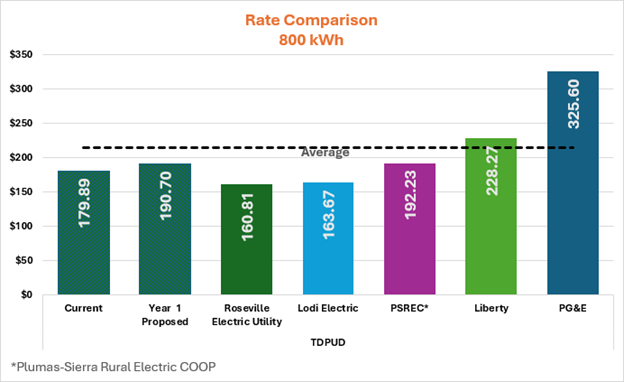
Our electric rates are in alignment with the average rates of regional public utilities in California and below the Investor Owned Utilities (IOUs). In addition, the proposed average 5% rate increases for 2026 and for 2027 are well below other electric utility rate increases. For most residential customers, the average monthly bill based on 800 kWh will increase by around $10/month.
Additionally, the IOU rate increases listed in the below table only include approved rate increases by the California Public Utility Commission. Both Liberty Utilities and PG&E have significant rate cases pending with the CPUC.
 What is TDPUD doing to ensure affordability?
TDPUD strives to stay true to its mission of balancing high-quality, reliable service with affordability. We understand this is a difficult financial time for many in our community, and across the country. We do not want to add to the burden. At the same time, we can’t be shortsighted, and we need to operate our utility in a way that ensures resiliency and reliability. We accomplish this through investments in projects that benefit our community and strengthen our infrastructure. But it’s important to note that some of the biggest increases in our budget are fixed costs driven by economic and market volatility that we have little control over.
What are some ways customers can have more control over their electric bills?
One of the most effective ways for customers to save money on their electric bills is by reducing their energy usage through conservation and efficiency. Visit tdpud.org/wintertips for advice on how to save energy in colder months, and go to tdpud.org/rebate to learn about the rebate programs we offer for energy efficient upgrades to your home.
The next step for customers would be to consider enrolling in our new time-of-use rate. This program charges customers a lower rate for using energy during off-peak hours, but charges more for energy use during peak times. This rate is best for customers who are able to shift the bulk of their energy usage to off-peak times.
Additional Rate Information
Power Cost Adjustment
What is Power Cost Adjustment?
A Power Cost Adjustment allows electric bills to reflect—up or down—changes in energy procurement costs, in order to adapt to short-term price changes in real time, without requiring a permanent rate change. The PCA is calculated and implemented quarterly, and is a new line item on customers’ monthly bills.
In 2025, thanks to solid planning and favorable energy markets, all four quarterly PCAs were credits. The TDPUD Board authorized energy billing credits totaling more than $2 million back to customers through Power Cost Adjustments. In total, these credits reduced average electric bills for the year by 5%, lowering the average monthly residential bill by $7, and more than $83 for the year.
Why did I receive a credit on my bill?
A Power Cost Adjustment credit is issued when power costs for the quarter are less than TDPUD budgeted for. All customers—residential and commercial—receive this credit on their bill for the following three months. If board approval of the PCA comes after the monthly billing cycle has begun, the credit will be spread over two months' bills, instead of three.
Why did you spend less than expected on procuring energy?
Many factors influence our energy purchasing costs. In the past, this discrepancy has been caused by lower prices than expected on resources like natural gas, landfill gas and wind. During the winter, energy usage is heavily influenced by heating costs. In milder winters, customers use less energy for heating, which results in less energy purchases than we plan for.
How do you calculate the credit amount?
The overall credit amount is determined by the amount of the budget overage. The exact credit amount each account receives is determined by usage.
When did TDPUD implement the Power Cost Adjustment?
The Power Cost Adjustment was approved in November 2023 as part of the 2024-25 electric rates. It went into effect on January 1, 2024.
Does a Power Cost Adjustment always result in a bill credit?
No. When there is a budget surplus for power purchasing, TDPUD no longer keeps that overage in reserves, which immediately benefits customers. However, it’s important to note that if there is a quarter where power costs exceed budget, that will result in a subsequent overage charge for customers.
Standby Charges
Standby charges have been assessed on vacant parcels in TDPUD's territory since 1975. These annual charges recoup TDPUD's operating and maintenance costs of the electric and water distribution facilities from parcel owners, who benefit from their vacant lot being in close proximity to the distribution facilities.
Electric Standby Charge
The current electric standby charge applies to vacant parcels with a TDPUD electric distribution line installed along an easement or along a public road or right of way, within 200 feet of the nearest exterior boundary line of any such parcel. The electric standby charge is $20 per year for each parcel 1 acre or larger, or $10 per year for each parcel less than 1 acre.
Primary and Secondary Rate
Truckee Donner Public Utility District provides two residential electrical rates:
Permanent Resident rate (P10) - billed to those customers who occupy their homes on a full-time basis.
Non-Permanent Resident rate (S10) - billed to those customers who occupy their homes on a part time basis for vacations, weekends, ski leases, etc.
Qualification for the permanent resident rate is at the District’s discretion and will be based on a combination of items from the below list. The following is a list of criteria used to determine a customer’s qualification for our permanent resident rate. Providing this information will assist us in determining your proper rate.
- Homeowner's exemption on the Truckee property per the Nevada/Placer County property tax record.
- Loan documents and/or homeowner’s insurance records indicating the Truckee residence as the primary residence.
- A local mailing address and daytime, evening and/or work phone numbers within the Truckee area.
- California driver’s license, and vehicle registration with local address.
- Voter registration in Nevada/Placer County showing the Truckee address in the TDPUD area.
- Employment in the Truckee area and/or Attendance of dependents at a local primary or secondary school.
- Information from District records.
Time-of-Use Electric Rate
TDPUD offers an optional Time-of-Use (TOU) Rate, which incentivizes customers to use energy during “off-peak” hours by providing a cheaper rate when energy is both less expensive to procure and often greener. This gives customers greater control over their energy bills if they make deliberate choices about when they use energy.
TDPUD sees its peak energy usage from 4 to 9 p.m. If customers can shift their energy usage to off-peak times, TDPUD will pass on the benefit it receives (cheaper energy purchases) by lowering the rate it charges during that time. However, the Time-of-Use Rate charges customers a higher rate during peak hours. It’s important to understand your energy usage before enrolling in Time-of-Use, to ensure it’s the right program for your household.
TDPUD Residential Electric Rates
|
TOU Rates |
TOU Rates |
Fixed Rates |
Fixed Rates |
|---|---|---|---|---|
Primary |
Primary |
Secondary |
Primary |
Secondary |
Off Peak |
$0.1567 |
$0.1782 |
$0.1976 |
$0.2247 |
Peak |
$0.3093 |
$0.3517 |
$0.1976 |
$0.2247 |
Interested in Time-Of-Use? Start here:
- Review your energy usage to see if Time-of-Use might be right for you.
- See the FAQ section for some things to look for to know whether this is the right option for your household.
- Before you enroll, implement changes and track your usage shift in your SmartHub account, to see what kind of difference a Time-of-Use Rate would make for your household. This will also help you get an idea of whether the necessary lifestyle changes are right for you and your household.
- When you’re ready to enroll in TOU, contact TDPUD customer service and ask to be switched to the Time-of-Use Rate.
- You can change your rate only once every 12 months, so be sure you’re making the right decision for your household’s needs before you enroll.
- In most cases, once you enroll the change will take effect in the next billing cycle. The first group to enroll in the program will be limited, so some people who sign up close to the launch may have to wait two billing cycles for the new rate to take effect.


Is Time-of-Use Right For You?
See which changes will create savings with a time-of-use rate.
Customers will get the most out of a Time-of-Use Rate if they modify their behavior to shift their energy use to off peak hours. It can be hard for some to avoid chores, cooking and other activities from 4-9pm, and if that’s the case then Time-of-Use wouldn’t be the best option for your household. But if you have the flexibility to achieve energy-intensive tasks during off-peak hours, you’ll see cost savings by enrolling in the Time-of-Use Rate. Here are some key ways to take advantage of TOU rates. If you can make some of the following changes, then Time-of-Use Rate may be a great option for you.
Off-Peak EV Charging
Charging an electric vehicle at home can increase your home's electricity needs by 50% or more! Moving such a large portion of your electricity demand to off-peak hours will result in major savings under a Time-of-Use Rate. Use your EV charger’s timer to set charging time for late at night or earlier in the day, rather than plugging in right when you get home from work. Three hours of charging costs $3.29 under the standard electric rate, but would drop to $2.61 during off-peak hours with a Time-of-Use Rate. If you charge your car every day, that’s a savings of $21 per month!
Dishwasher Delay
Use your dishwasher’s delay function to set the appliance to run during off-peak times. This is an easy way to shift your usage without having to remember to start the dishwasher once peak period ends. What would usually cost 30 cents will cost 24 cents instead, amounting to a savings of $2 a month if you run the dishwasher daily.
Thermostat Set Points & Pre-Cooling
Pre-cooling is the best way to cut down on AC energy costs under a Time-of-Use Rate, to avoid needing to run it during the peak time when rates are higher. If you run your AC when it is cooler outside—in the early morning and evening—it won’t have to work as hard to bring the temperature down, which will take less energy. With pre-cooling, you aim to cool your home to a few degrees lower than your preferred temperature, and then turn your AC off and coast through the day.
You should also utilize thermostat set points. The EPA recommends 68 and 78 as heating and cooling set points. This is a good place to start, and then you should set it to as warm (summer)/cool (winter) as you can handle. If your home is going to be unoccupied then set your thermostat back to 85 degrees in the summer and 50 degrees in the winter. Don’t let your heating and cooling work overtime when there’s no one home! You can save as much as 2% for every degree you set your thermostat back!
Off-Peak Clothes Washing & Drying
If you can wash and dry your clothes after 9pm or before 4pm, you’ll save 14 cents for every load you do if you switch to a Time-of-Use Rate.
Time-of-Use Rate FAQ
What is a time-of-use rate?
A Time-of-Use Rate applies different electric rates at different times of day for the cost of any electricity you use. The day is split into “peak” and “off-peak” times. Customers who enroll in Time-of-Use are charged a lower rate for the electricity they use in off-peak hours, but a higher rate for peak hours.
What does TDPUD consider peak hours?
Peak hours are 4 to 9 p.m. Off-peak is all other hours.
Why does TDPUD offer a time-of-use rate?
Time-of-Use Rates are a great tool for some customers to save money on their electric bills while also reducing greenhouse gas emissions. For other ways to reduce your energy use, check out our rebate offerings at tdpud.org/rebate.
The savings that occur by using energy in off-peak times can benefit both the customer and the utility. Energy is cheaper and often greener to purchase during off-peak hours. If customers can shift their energy usage to those times, then TDPUD offers them a lower electric rate, because the energy costs less to procure.
Do all customers have to switch to a time-of-use rate?
No, Time-of-Use is an optional program, and TDPUD only wants customers to switch if it will benefit their household.
How do I know if a time-of-use rate is right for my household?
Time-of-Use is most beneficial for customers who can shift most of their energy use to off-peak hours. This is most attainable for households that utilize electric space heating, air conditioning, electric water heating, and/or EV charging. Check out our guide to see how much money you could save with your specific appliances.
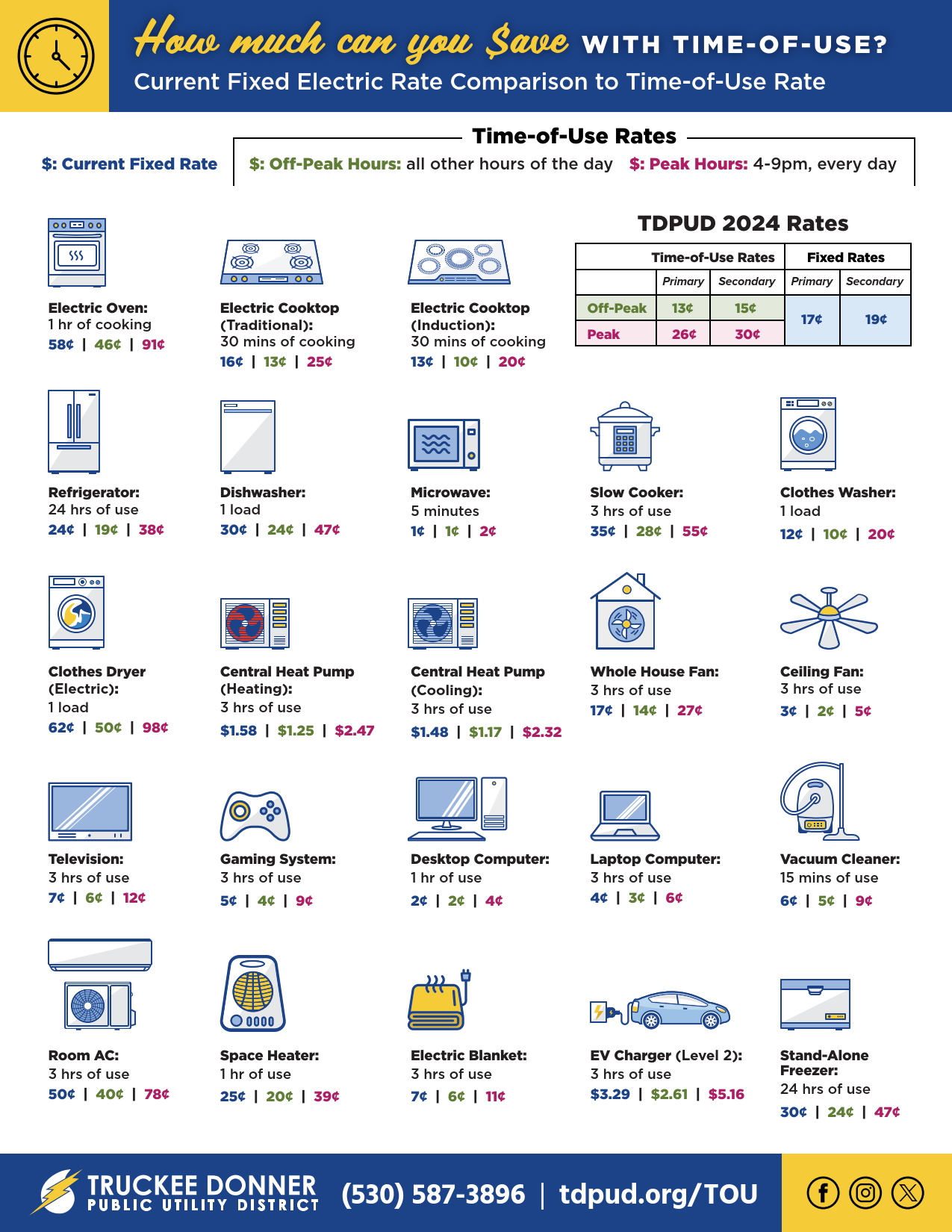
Before you enroll in time-of-use, it is important to analyze your energy usage and test whether you can make the lifestyle changes necessary to see the benefit of the program.
- Log in to your online TDPUD SmartHub account to review your energy usage. Take note of when your energy use spikes, as well as seasonal trends.
- Do a trial run; implement changes to shift your energy usage to off-peak hours. After a few weeks, review your energy usage once again, and see if you made enough of a change to benefit from the time-of-use rate.
How do I enroll in time-of-use rate?
Call or email TDPUD’s customer service department at 530-587-3896 or service@tdpud.org to speak to a TDPUD representative who can enroll you in Time-of-Use. In most cases, once you enroll the change will take effect in the next billing cycle. The first group to enroll in the program will be limited, so some people who sign up close to the launch may have to wait two billing cycles for the new rate to take effect.
Do I need to any special equipment to be eligible for the time-of-use rate?
No, the standard meters in TDPUD’s territory already have the capability to measure electricity use in the way that is needed to calculate Time-of-Use. No meter upgrades are necessary.
How can I un-enroll from time-of-use if I realize it’s not the right plan for my household?
TDPUD electric customers can only change their rate once a year. Once you enroll in Time-of-Use you will have to wait 12 months until you are able to change back to the standard rate. This is why it’s important you do some research into understanding whether Time-of-Use is the right option for your household before you enroll.
Are all residential customers eligible to enroll in time-of-use?
No, customers who are enrolled in our equal payments plan or pre-paid program are not eligible for Time-of-Use.
Are commercial customers eligible to enroll in time-of-use?
Not yet. Currently only residential customers are eligible, but we will be working to add commercial customers to this program in the future.