

Water Conservation
Using Water Wisely:
What California’s New Regulation Means for Our Community
The State of California now requires all Urban Retail Water Suppliers—including TDPUD—to meet specific water conservation targets. This isn’t something TDPUD created. It’s a statewide regulation designed to ensure California communities are prepared for a drier future.
The good news? We’re in this together: Compliance is measured for the Truckee community as a whole, not household by household. No individual monitoring, no individual fines. If we meet the target together, everyone benefits. However, failure to meet the goal may result in financial penalties for TDPUD, which could translate to water rate increases in the future.
TDPUD customers will need to consider how to can reduce both their indoor and outdoor water usage. California's indoor use target is 47 gallons per person per day, and big reductions in outdoor irrigation will need to happen to achieve the target. TDPUD is also doing its part by fixing pipeline leaks and installing monitoring technologies to reduce water loss in its water distribution system.



Enter TDPUD's Native Garden Photo Contest
Think you’ve got the best native and drought-tolerant garden or landscaping in Truckee? Show it off! You could win a $150 credit on your water bill!
Many TDPUD water customers will need to rethink their landscaping in the coming years, to remove or reduce plants and lawns that require a lot of water to thrive. The Patricia S. Sutton Conservation Garden is a great place to start for ideas on how to incorporate water-wise elements, but we also know we have plenty of customers who already have beautiful gardens that could serve as inspiration for their neighbors.
This contest rewards customers who take steps to reduce their outdoor irrigation water use, and also helps other TDPUD customers see realistic examples of water-wise landscaping that can thrive in Truckee.
To enter, send an email to contest@tdpud.org with your name, TDPUD account number and a picture of your native and drought-tolerant garden or landscaping. Entries will be accepted starting Thursday, Aug. 20 until Thursday, Sept. 10. Voting will begin on Friday, Sept. 11, and will close on Wednesday, Sept. 16. The inaugural contest winner will be announced on Thursday, Sept. 17 at the Truckee Community Block Party.
*Contest participants must be TDPUD water customers to qualify. No purchase is necessary to enter. Winners will be chosen by a public vote, facilitated by TDPUD. By submitting a photo to the contest via email, participants are releasing the photos to TDPUD to share publicly for the contest and granting future permission to TDPUD to use the photos in future educational or promotional materials. Entries will be vetted by TDPUD staff to ensure that they represent a qualifying native and drought-tolerant garden or landscaping feature.
Water Conservation Rebates
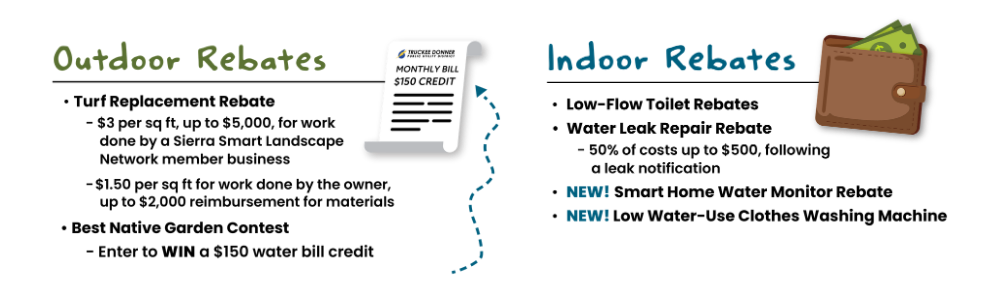
Visit our rebates webpage for more information on these programs.
______________________________________________________________
Water Conservation Resources


Click here to download TDPUD's water conservation informational flyer, shown above.
Click here to read the Making Conservation a California Way of Life Fact Sheet, created by the State Water Resources Control Board.
Visit the State Water Resources Control Board's website for more information on this regulation.
