
Water Rates
Water - Residential Metered Rates
The domestic water rates for single family properties, individual condominium units and townhouse units equipped with a meter shall consist of three components - a base charge, a commodity charge and a pump zone charge.
|
2025 |
2026 |
2027 |
|---|---|---|---|
Base Charges |
|||
Up to 3/4" |
$103.03 |
$108.50 |
$115.55 |
1" |
$122.89 |
$129.41 |
$137.82 |
More than 1" charged as Commercial |
|||
Residential Consumption (per 1,000 gallons) |
|||
0 - 8,000 gallons (block 1) |
$1.34 |
$1.75 |
$1.86 |
8,000+ gallons (block 2) |
$1.91 |
$2.37 |
$2.53 |
Pump Zone Charges (per 1,000 gallons) |
|||
Zone 1 |
$0.00 |
$0.00 |
$0.00 |
Zone 2 |
$1.03 |
$1.09 |
$1.16 |
Zone 3 |
$2.04 |
$2.16 |
$2.30 |
Zone 4 |
$3.06 |
$3.24 |
$3.35 |
Zone 5 |
$4.08 |
$4.32 |
$4.60 |
Zone 6 |
$5.10 |
$5.40 |
$5.75 |
Zone 7 |
$6.12 |
$6.48 |
$6.90 |
Water - Commercial Metered Rates
The commercial water rates for all other multiple dwelling units, trailer parks, public use, dedicated irrigation and commercial establishments shall consist of three components - a base charge, a commodity charge and a pump zone charge.
2025 |
2026 |
2027 |
|
|---|---|---|---|
Base Charges |
|||
Up to 3/4" |
$103.03 |
$108.50 |
$115.55 |
1" |
$122.89 |
$129.41 |
$137.82 |
1.5" |
$172.75 |
$181.92 |
$193.75 |
2" |
$237.50 |
$250.11 |
$266.37 |
3" |
$397.58 |
$418.68 |
$445.90 |
4" |
$568.87 |
$599.06 |
$638.00 |
6" |
$853.30 |
$898.60 |
$957.00 |
8" |
$1,066.62 |
$1,123.23 |
$1,196.24 |
Commercial Consumption |
|||
$/1,000 gallons |
$1.86 |
$1.92 |
$2.04 |
Pump Zone Charges (per 1,000 gallons) |
|||
Zone 1 |
$0.00 |
$0.00 |
$0.00 |
Zone 2 |
$1.03 |
$1.09 |
$1.16 |
Zone 3 |
$2.04 |
$2.16 |
$2.30 |
Zone 4 |
$3.06 |
$3.24 |
$3.35 |
Zone 5 |
$4.08 |
$4.32 |
$4.60 |
Zone 6 |
$5.10 |
$5.40 |
$5.75 |
Zone 7 |
$6.12 |
$6.48 |
$6.90 |
How Do Our Water Rates Compare?
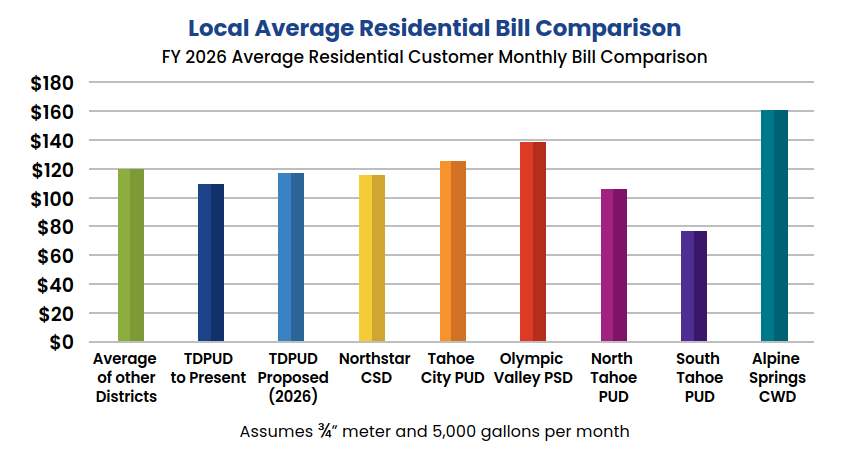
Our water rates are in alignment with the average rates of neighboring public utilities in the Truckee-Tahoe region, and other local water utilities have announced comparable or higher rate increases for the next few years. A typical household using 5,000 gallons per month will see average costs in line—or lower—than the regional average.
Additionally, TDPUD does not receive any property tax dollars. Some agencies included in the below graph do receive property tax funds, which subsidizes their water rates.
Year |
Water % Increase |
|---|---|
2026 |
6.5% |
2027 |
6.5% |
(average across all customer classes)
Your Water Rate Questions, Answered
What are the water rate increases for 2026-2030?
TDPUD adopted an annual increase of 6.5% each year from 2026 to 2030. This represents the average increase across all customer classes. Customers can find more specific information about how these increases would impact their specific bill in our Notice of Public Hearing: Proposed Water Rate Increases for 2026-2030
TDPUD reviews and updates its water cost of service on a five-year basis, to propose rates to ensure that we can maintain our system and deliver reliable service, in a way that is equitable for our rate payers.
While TDPUD analyzes its cost of service on a five-year basis, the Board adopts budgets on a two-year basis. This is why we focus primarily on the 2026 and 2027 rates in our discussions at this time, since we are currently in the process of setting the 2026-27 budget.
TDPUD’s Board of Directors held a public hearing and received public comment on Wednesday, Nov. 19 at 6pm. As part of the Proposition 218 public process, TDPUD customers had the opportunity to protest and/or object to the proposed water rates. Specific information on the difference between a protest and an objection, how to submit and deadlines for each, can be found in the below documents.
Review the following documents to learn more
- Notice of Public Hearing: Proposed Water Rate Increases for 2026-2030
- 2025 Water Rate Study
- Prop 218 Written Objection Form
What does this mean for my bill?
Following the adoption of the 2026-2030 water rates, customers will see on average a 6.5% increase annually for the next five years.
For example, if you have an average bill of $115 in 2025, this is what you would pay for the next five years (rounded to whole dollars):
- 2025: $115/month
- 2026: $122/month (+$7 to prior year)
- 2027: $130/month (+$8 to prior year)
- 2028: $138/month (+$8 to prior year)
- 2029: $147/month (+$9 to prior year)
- 2030: $157/month (+$10 to prior year)
(assuming similar water usage YOY and applying the average increase amount)
It should be noted that 6.5% is the average increase across all customer classes. Specific increases may vary slightly. Proposed increases for every customer class can be found in the 2025 Water Rate Study, beginning on page 80.
Here is an example of how this rate increase would affect a residential customer living in Pump Zone 2, using 3,000 gallons per month. Their total monthly bill would increase by $6.88 in 2026 if the proposed water rate increase is adopted. An explanation of what the different parts of the bill mean, and how the increase affects each one can be found later in this FAQ.
|
2025 Rates |
2026 Rates |
|---|---|---|
Base charge (3/4" meter) |
103.03 |
108.5 |
Commodity charge (3,000 gal) |
4.02 |
5.25 |
Pump zone charge (Zone 2) |
3.09 |
3.27 |
Total |
110.14 |
117.02 |
What does my water bill pay for?
Water rates pay for everything it takes to deliver water to our customers. This includes costs associated with system maintenance, water pumping, water delivery, capital infrastructure projects, administration, regulatory compliance, including water quality testing, leak repairs and water loss reduction and wildfire system hardening.
How does TDPUD determine its cost of service?
TDPUD hires an independent, experienced consultant to analyze past and current data to determine our predicted water cost of service and produce a rate study that determines what our water rates need to be set at for TDPUD to be able to fund the water utility. This information was presented to the TDPUD and public in Fall 2025, and is available on the TDPUD website.
What do the different parts of my water bill mean?
Base Charge: this is a monthly fixed service charge that covers operational costs, maintenance and administrative expenses. All water utility customers pay a base charge to fund critical infrastructure, such as pump facilities, pipelines and hydrants.
All customers must pay for the water system to be functional and be properly maintained. You are paying for the system to be ready to serve you when you are using water.
Commodity Charge: this is based on what it costs to produce the water from the source, so it is measured by the amount of water you use. On your bill, you will see the commodity charge represented in a price per 1,000 gallons. We do this because the cost per gallon is so small, it is difficult to represent. But that does not mean you are billed per thousand gallons of usage. If you only use 400 gallons of water, that is the amount you will be billed for.
For residential customers, there are two pricing tiers: 0-8,000 gallons per month usage and 8,000+ gallons per months usage. If you use less than 8,000 gallons per month, you will be billed at $.00134/gallon (or $1.34 per 1,000 gallons). If you use more than 8,000 gallons, you will be billed at $.00191/gallon (or $1.91 per 1,000 gallons).
Pump Zone Charge: this accounts for the energy costs of pumping water to your specific location, particularly if you are in a higher elevation zone. This is because pumping is very energy intensive, and the energy costs needed to deliver water to you at a higher elevation are a portion of the water utility’s cost of service.
There are seven total pump zones. Pump zone 1 does not pay a pump zone charge. Pump zone 7 pays $.00612/gallon (or $6.12 per 1,000 gallons). The increases between pump zones are incremental.
More Water Rate FAQs
How will each part of my water bill be affected by the rate increases?
Rate increase by bill section for residential customers:
- Base Charge:
- 5/8" x 3/4" inch meter: $103.03 to $108.50 (5.3% increase)
- 3/4" meter: $103.03 to $108.50 (5.3% increase)
- 1" meter: $122.89 to $129.41 (5.3% increase)
- Commodity Charge:
- 0-8,000 gallons: $1.34 per 1,000 gallons to $1.75 per 1,000 gallons (30% increase)
- 8,000+ gallons: $1.91 per 1,000 gallons to $2.37 per 1,000 gallons (24% increase)
- *When measured by percent increase, this change appears large, but it amounts to less than .50 cents per thousand gallons.
- Pump Zone Charge: 5.9% increase across Zones 3-7, 5.8% increase for Zone 2
What would happen if the 2026-2030 rate increases were not adopted?
TDPUD is here to serve the needs and interests of our community. If more than 50% of the community protests the rate increase and it is not adopted, TDPUD will not be able to fund the Board-approved capital improvement projects it has planned for the next five years, which address our aging infrastructure.
TDPUD’s board would be required to re-engage with its consultant, HDR, for further review of the revenue requirements needed to fund the water utility, and as a result TDPUD would likely need to defer and/or re-prioritize planned maintenance and capital projects. This would likely result in delayed and/or postponed projects, potentially resulting in increasing costs due to an expanded project timeline.
TDPUD manages $160 million in water capital assets and has a responsibility to sustainably manage these investments, ensuring responsible financial stewardship for our ratepayers, which is the reason behind the proposed water rate increases.
Why does TDPUD need more water revenue? Why can’t the rate stay the same?
As a public utility, TDPUD’s utilities are funded almost entirely by rates, and these rates are based on the actual cost of service to operate the utility. It’s no secret that costs are rising in every aspect of our lives, and the cost to operate the water utility is not immune to the same cost pressures. Some of the major factors driving TDPUD’s water utility cost of service is system maintenance, increasing capital infrastructure replacement costs and compliance with state and federal regulations.
Increasing Costs of Capital Infrastructure Replacements and System Maintenance: The cost of equipment and construction is rising, and we’re still experiencing the impacts of supply chain issues. When needed, we replace and rehabilitate aging systems, or install new pipelines, pump stations, tanks and wells. TDPUD’s Board has adopted a Capital Improvement Plan that outlines high-need projects to address aging infrastructure, in order to ensure TDPUD can reliably serve its customers.
Compliance with State and Federal Regulations: There are a number of “unfunded mandates” TDPUD must comply with, meaning that there are regulations that are imposed on public water systems that we have to foot the bill for. TDPUD invests in technologies, testing and staff to ensure compliance and deliver high-quality water that meets all state and federal standards. This includes investments in water testing, leak detection and conservation as well as wildfire system hardening.
Is this increase compliant with California law that says utility fees must be based on the actual cost of service?
Yes. These proposed rate increases are based on the recent cost of service study compiled by HDR, an independent, experienced consultant hired by TDPUD.
Note: See page 80 of the linked PDF for examples of how the proposed rate increase will impact residential base charges and commodity charges, and page 82 for the impacts to pump zone charges.
Can’t we just defer the maintenance and keep rates the same?
A significant portion of TDPUD’s potable water system was constructed between 1965-1975. While TDPUD has made significant investments into pipeline and pump station replacements, there are portions of TDPUD’s infrastructure that are approaching or have exceeded their useful life. TDPUD adopts multi-year Capital Improvement Plans, in order to plan that work over time and minimize the financial impact to rate payers.
Delaying this work will save money in the short term, but it will likely lead to higher costs later on.
What is a pump zone charge? Why do some customers have to pay a higher pump zone charge?
One of the water utility’s biggest variable costs is energy, and it takes a lot of energy to pump water uphill. Therefore, it costs more to serve customers at higher elevations. TDPUD splits the community into pump zones based on elevation. This makes this cost equitable, so people who live at lower elevations aren’t subsidizing the cost it takes to serve higher elevation homes.
Why does my bill not seem to change that much even when I’m away or my water use is down?
As documented in the HDR cost of service study, approximately 85% of your bill is a fixed charge. This charge covers capital infrastructure projects, operational costs, system maintenance and regulatory compliance. Fixed charges are standard on water bills and are determined by the size of your meter.
All customers have to pay for the water system to be functional and be properly maintained. You are paying for the system to be ready to serve you when you are using water.
How do TDPUD’s water rates compare to other regional water utility rates?
TDPUD’s water rates are in line with others in the region, and other Tahoe-area water utilities have announced comparable or higher rate increases for the next few years.
Additionally, TDPUD does not receive any property tax dollars. Some agencies included in the below graph do receive property tax funds, which subsidizes their water rates.
TDPUD said we have a plentiful water resource? Why then do we need to spend more money?
Our abundant and sustainable water resource does not cancel out the need to invest in our infrastructure, nor does it allow us to refuse compliance with state regulations related to water conservation. The amount of water available to us only helps keep rates in check. The fact that we utilize a groundwater resource rather than a surface water resource does help lower our costs, because we don’t need to build and operate a treatment plant.
How can I participate in the water rate process?
We are governed by a locally-elected board chosen by the community. Board meetings are open to the public, held on the first and third Wednesday of each month. The public is welcome to attend these meetings and share their opinions with the Board either during the public comment period towards the beginning of the meeting (for items not on the agenda), during an item on the agenda, or by submitting a written public comment on our website. Two water rate workshops were held during regular board meetings over the past two months, as well as two budget workshops.
In California, water rates are subject to Proposition 218. For this process specifically, parcel owners have the opportunity to protest or object to the proposed rates. Information on how to do this is included in the mailer that was sent in September to all parcel owners who receive TDPUD water service.
How can I be sure that TDPUD is spending money efficiently?
Truckee Donner PUD demonstrates efficient spending because it prioritizes transparency and responsible management at every level. Oversight comes from a locally-elected Board of Directors, which reviews and approves TDPUD’s budget and capital projects. TDPUD staff follow’s the board’s direction, while the board remains accountable to the community through open public meetings and your participation as a voter. This ensures every financial decision is community-guided and openly reviewed, so resources are invested wisely where they matter most.
TDPUD’s budget and rate processes are transparent and provide ample opportunity for public comment. Prior to a budget or rate adoption, workshops are held at regularly scheduled board meetings, to allow the public to understand the rate- and budget-setting processes. The public is welcome to attend these meetings, and there are opportunities at these meetings for the public to make comment on items on the agenda, or even general items they want to address before the Board of Directors. If you cannot attend in person, these meetings are livestreamed on YouTube, and recordings of past meetings can also be found on the TDPUD YouTube page. For more information on board meetings, visit tdpud.org/boardmeetings.
TDPUD strives to balance customer rate affordability with its fiduciary responsibility to ensure reliable and safe water service to the entire community, in alignment with TDPUD’s mission and strategic goals.
How can I protest a rate increase?
During the Proposition 218 Process, which TDPUD completed in Fall 2025, water customers could submit a protest in writing to TDPUD. This could've be done via email (send to publiccomment@tdpud.org), dropped off in person to our office at 11570 Donner Pass Rd. or mailed to 11570 Donner Pass Rd., Truckee, CA 96161.
Written protests must include the service address or assessor’s parcel number (APN), the name of the person protesting, signature of the person protesting and clearly state that it constitutes a protest of the proposed new rates. Protests could be submitted by either the homeowner or a tenant of any property serviced by the TDPUD water utility, but only one protest per parcel or service address could be submitted. Protests needed to be received by the close of the public hearing on November 19, 2025.
If a majority of property owners and/or the tenants of the property whose property receives water service had filed valid written protests prior to the close of the public hearing on November 19, 2025, the proposed water rates would not have been approved.
More information can be found in the mailer that was sent to all parcel owners who receive TDPUD water service. Click here to access that mailer, called "Notice of Public Hearing: Proposed Water Rate Increases for 2026-2030."
What is the difference between a protest and an objection?
If you disagree with the water rate increase and want to express that you don’t want it adopted, you can file a protest. If you think that TDPUD did not comply with state law in this water rate process and wish to preserve the ability to legally challenge the proposed rates, then you must file an objection.
As described above, a protest requires the customer to submit a simple written protest, which can be done via email. An objection must be submitted with a specific form, which can be accessed here. Objections require a wet signature and must be mailed or hand-delivered to the TDPUD office by 5pm on November 7, 2025.
More information can be found in the mailer that was sent to all parcel owners who receive TDPUD water service. Click here to access that mailer, called "Notice of Public Hearing: Proposed Water Rate Increases for 2026-2030."
Current Rates
Additional Rate Information
Standby Charges
Standby charges have been assessed on vacant parcels in TDPUD's territory since 1975. These annual charges recoup TDPUD's operating and maintenance costs of the electric and water distribution facilities from parcel owners, who benefit from their vacant lot being in close proximity to the distribution facilities.
Water Standby Charge
The current water standby charge applies to vacant parcels with a TDPUD water distribution line not less than two inches in diameter installed within 100 feet of the nearest exterior boundary line of any such parcel. The current water standby charge is $80 per parcel per year.